
As cities move toward cleaner, decentralised energy systems, one technology is emerging as a key enabler of this transition: Advanced Energy Management Systems (EMS). In early March, Steinbeis Europa Zentrum met with Spectral, an Amsterdam-based clean-tech company. Stefan Kop, a Strategic Business Developer at Spectral, talked about how EMS solutions are evolving, what challenges still exist, and how cities can prepare for scalable district-level smart energy management.
Why Energy Management Systems Matters
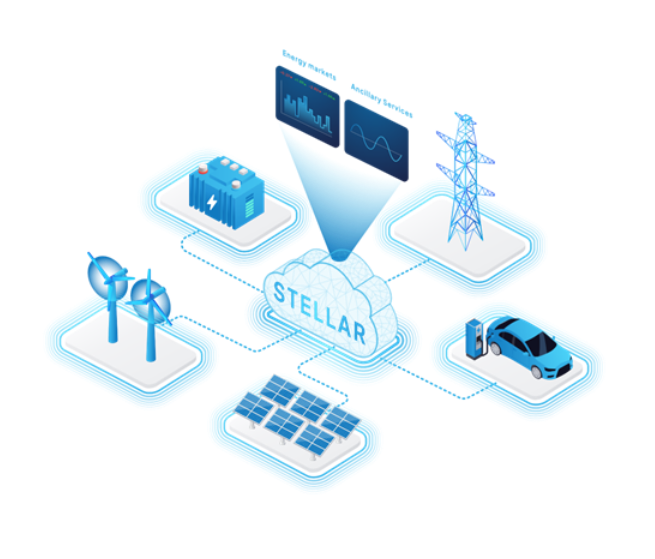
Stefan explained that the energy sector is undergoing a fundamental shift: from a world dominated by a handful of large power plants to one where local energy communities and districts play an active role. And EMS are the key enablers of this transformation since it acts as the “brain” of decentralised energy systems. By coordinating PV, batteries, EV charging and heat pumps in real time, it enables communities to react to market signals and remain within grid limits, crucial in times of increasing grid congestion.
One major driver for advanced EMS is grid congestion. When electricity grids reach capacity limits, new grid connections are restricted. An EMS helps sites manage these constraints while extracting value from flexibility.
“An EMS is the enabler that allows local communities to actively participate in the energy system while remaining within the grid limits.” – Stefan Kop, Spectral
From Communities to Districts
Projects like Schoonschip and Republica served as early living labs for testing EMS under a single grid connection (based on an exemption on the Dutch electricity law). They allowed Spectral to gain strong experience in local optimisation. But according to Stefan, the real growth potential now lies at district level, where multiple buildings or communities are virtually pooled and operated collectively. These “energy hubs” introduce new technical and organisational complexities, from more advanced control algorithms to agreements between multiple stakeholders. But they also unlock much greater flexibility.
What Spectral’s Advanced EMS Looks Like
Stefan broke down the advanced EMS of Spectral, named STELLAR, into three layers:
1. Real-time asset control
2. Vertical integration with energy markets and external players
3. Dashboards and data services for users and operators
Combining these layers allows “value stacking”, using one asset for several services such as peak shaving, imbalance trading and frequency response. This leads to better asset utilisation and stronger business cases.
Key Challenges and Market Trends
Scaling EMS from bespoke pilot solutions to widely deployable products is not straightforward. Spectral is actively transitioning from custom engineering to more standardised, productised offerings. At the same time, shifting regulations, market rules, and grid operator contracts create uncertainty for both providers and clients. Spectralworks closely with DSOs and TSOs to anticipate changes and influence future frameworks.
“The future lies in district‑level energy hubs where flexibility can be shared and optimised collectively.” – Stefan Kop, Spectral
AI, New Markets, and Emerging Use Cases
Artificial Intelligence already plays a role in short-term forecasting and optimisation, and its importance is increasing. Stefan stressed that AI is currently a powerful tool rather than a full replacement for human developers, but its applications are expanding. Spectral also sees major opportunities in new markets such as Poland – where PV, wind, and storage are growing rapidly – and in new use cases like unlocking flexibility from buildings by controlling the heating, cooling and ventilation system in combination with batteries and EV chargers, which requires advanced coordination between the assets while taking into account grid constraints.
Replication Across Europe: Standardisation vs. Local Adaptation
For EMS solutions to scale across cities and countries, standardisation is essential. Integrating with metering infrastructures, market rules, and asset types should be as uniform as possible. However, the first projects in each new country often require significant local customisation before a standardised approach becomes feasible.
Lessons from ATELIER and Advice for New Energy Communities
One of the key lessons from the ATELIER project was the importance of clearly defined responsibilities and expectations. In such long, multi-year demonstration projects, unclear roles can slow progress, especially in a fast-moving market like EMS.
For new energy communities, Stefan emphasised asking the right strategic questions early on: What is your ambition? Are you optimising for cost, sustainability, price stability, or self-consumption? These answers shape the required EMS features and system design.
The Road Ahead: Virtual Power Plants and Beyond
Looking into the near future, Stefan expects virtual power plants (VPPs) to become mainstream. By pooling distributed assets, from solar farms to batteries to energy communities, EMS providers can offer flexibility to the grid in a coordinated way. This mirrors the capabilities of a traditional power plant but built from hundreds of decentralised units.
About Spectral:
Founded in 2015 as a spin-off from Metabolic, Spectral has grown from a small venture to a specialised EMS provider with two major platforms: STELLAR (for unlocking flexibility and facilitating market participation for utility companies, large assets owners and energy communities) and BRIGHTER (for energy optimisation in the real estate sector). The company is expanding internationally, building partnerships for installation, operation, and sales. “What sets Spectral apart is our technology- and party-agnostic approach. By avoiding market positions that compete with our clients, we act as an impartial IT integrator – capable of connecting any asset, market, or application.” says Stefan Kop.